Back during my undergraduate days at Georgetown, Father Schall, my political theory professor, used to advise us that great works were best enjoyed when read in the location in which they were written. The politics of Cicero were best pondered on the streets of Rome. Rousseau's discourses were best read in a Parisian cafe. John Locke's democratic ideals should be contemplated over a pint in a British pub. Finally seven years later, I finally put Fr. Schall's suggestions into practice... sort of. Before embarking upon my recent trip to Senegal, I picked up a copy of Jeffrey Sachs' End of Poverty. While I'm sure Professor Sachs wrote most of this book in his office at Columbia University, much of the research that went into the book was gathered in Africa. And Fr. Schall was correct, reading about a subject in the location does make the work more impactful somehow. Learning about development issues in Africa from Africa, makes everything seem more real and in your face.
Sachs attempts to write a roadmap for ending extreme poverty over the next two decades, a goal championed by the United Nations' Millienium Goals. Despite the seemingly impossible task he sets out for himself at the start of the book, I finished the book convinced that it was all very possible and that he had the strategy to accomplish it. It's quite an amazing book. He starts out by setting the stage: presenting the most challenging regions to gloabal developement. He then goes on to give specific reasons as to why some countries have achieved development while others have not, despite the fact the all countries started off at basically the same starting point back in the 17th Century when everyone was poor. Next, he chronicles some of the work that he has done personally in Bolivia, Poland, Russia, etc. to battle hyperinflation and help get those countries back on track. After laying out the case and what needs to be done, he spends the second half of the book detailing how to do it, how to pay for it and why it's in the interest of the rich to actually do it. I was thoroughly impressed by the whole endeavor.
Now that Sachs has clearly shown that it is indeed possible, at least theoretically, to end poverty by 2025 (the target date of the UN Millenium Development Goals), the really hard part is to convince world leaders and the electors in democratic societies to actually do it. How we accomplish that goal isn't covered in this book, but maybe that's someone else's job. With this book, Sachs has led us to the water, but now it's up to the rest of us to take a drink.
Tuesday, August 08, 2006


Monday, August 07, 2006
Shots
Here are a few shots from Senegal. Enjoy.
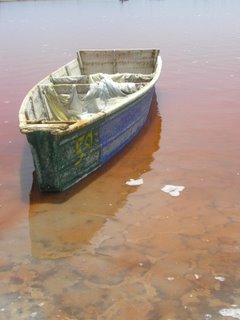
Lac Rose

The Locals
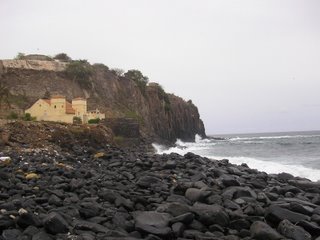
Goree Island
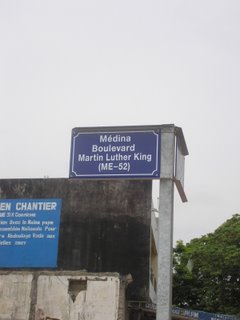
MLK Worldwide
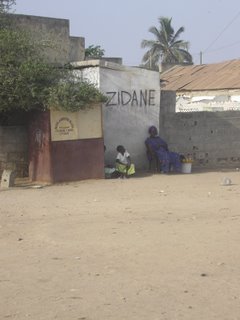
Football Fans
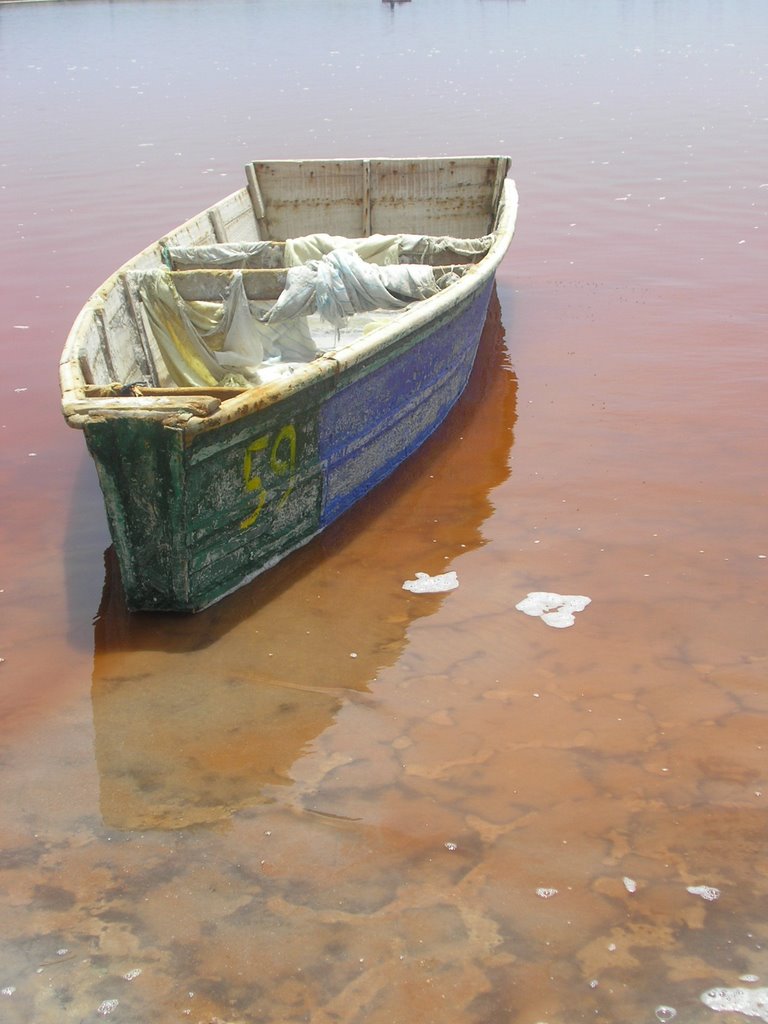
Lac Rose
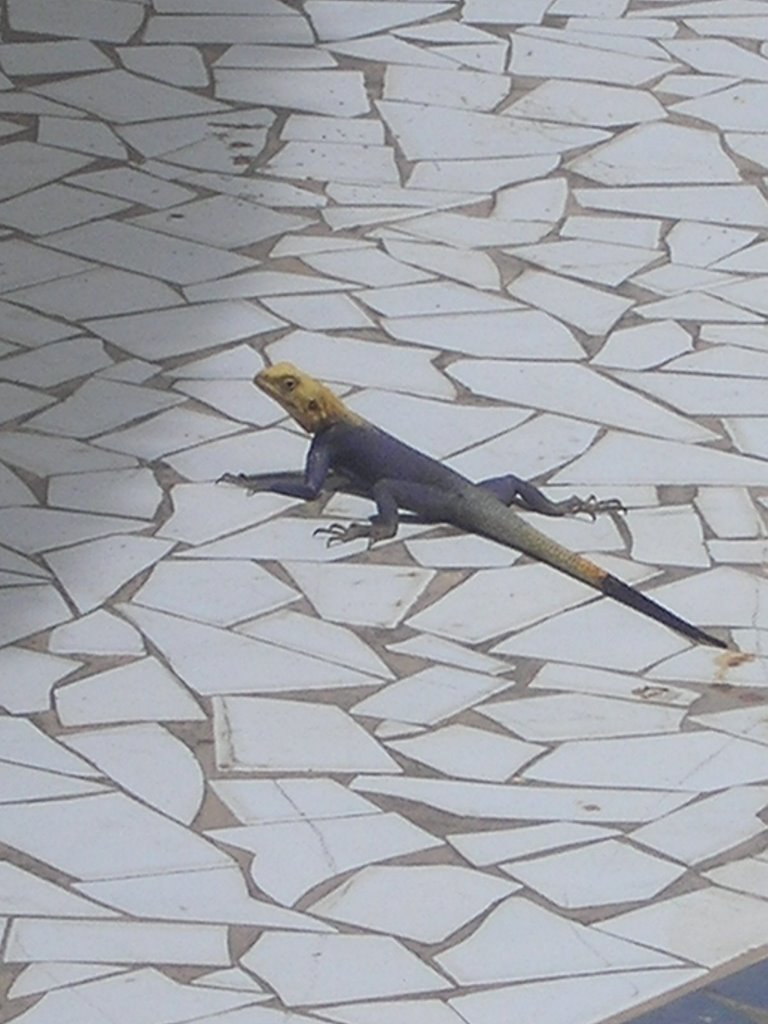
The Locals
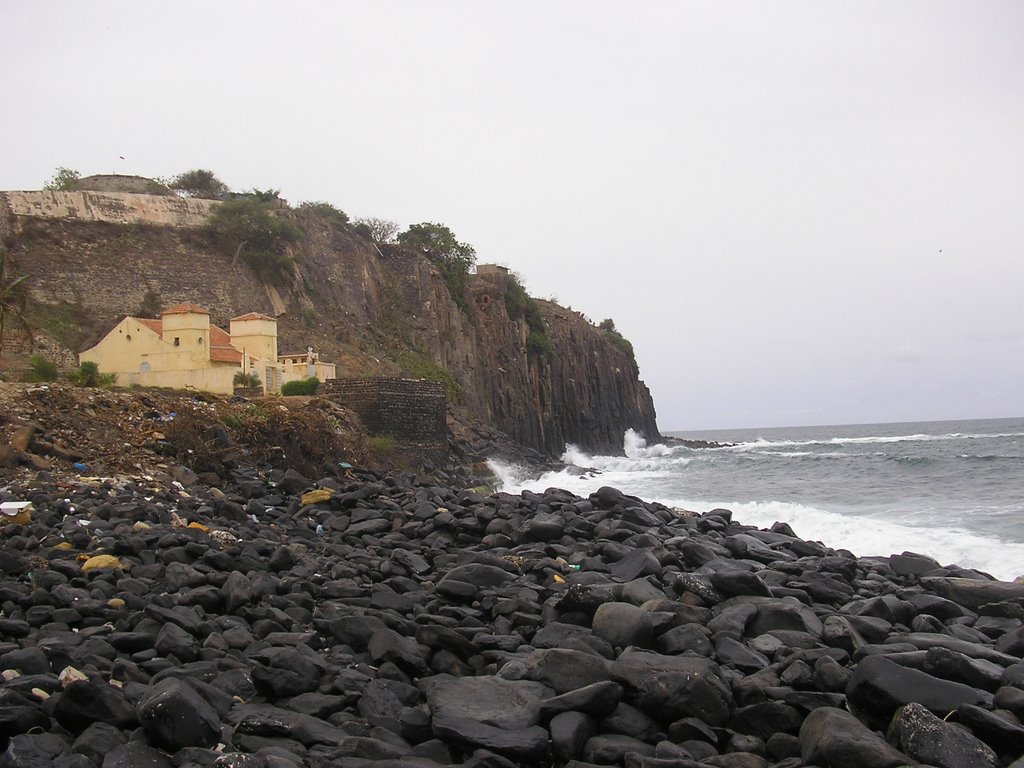
Goree Island
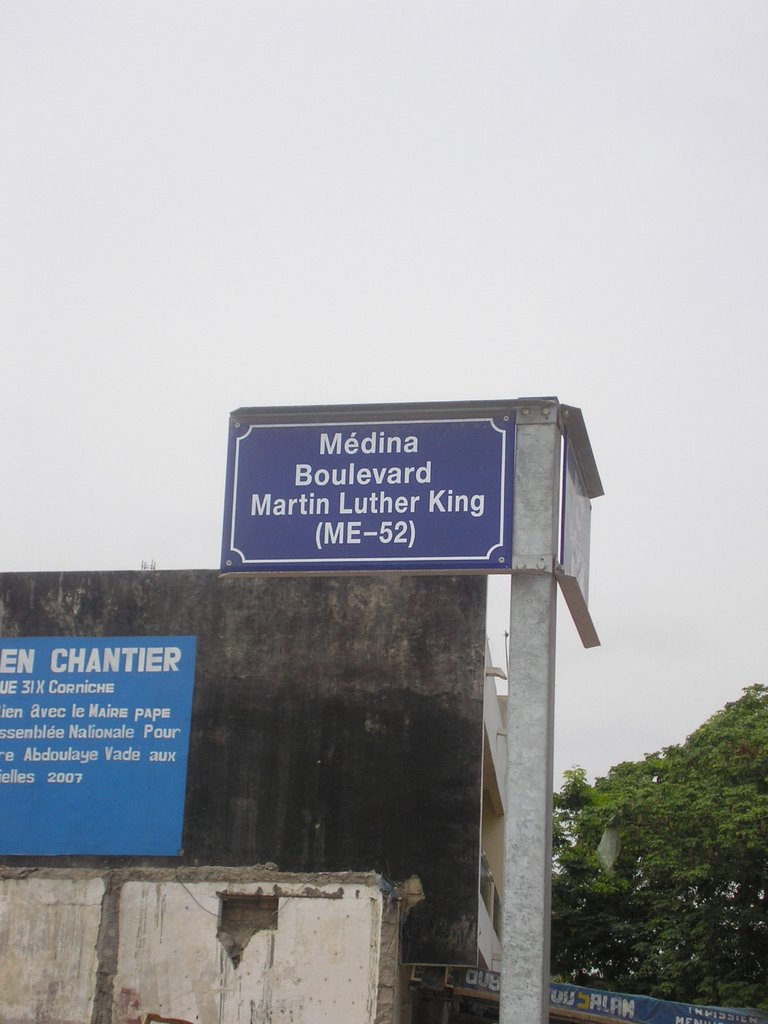
MLK Worldwide
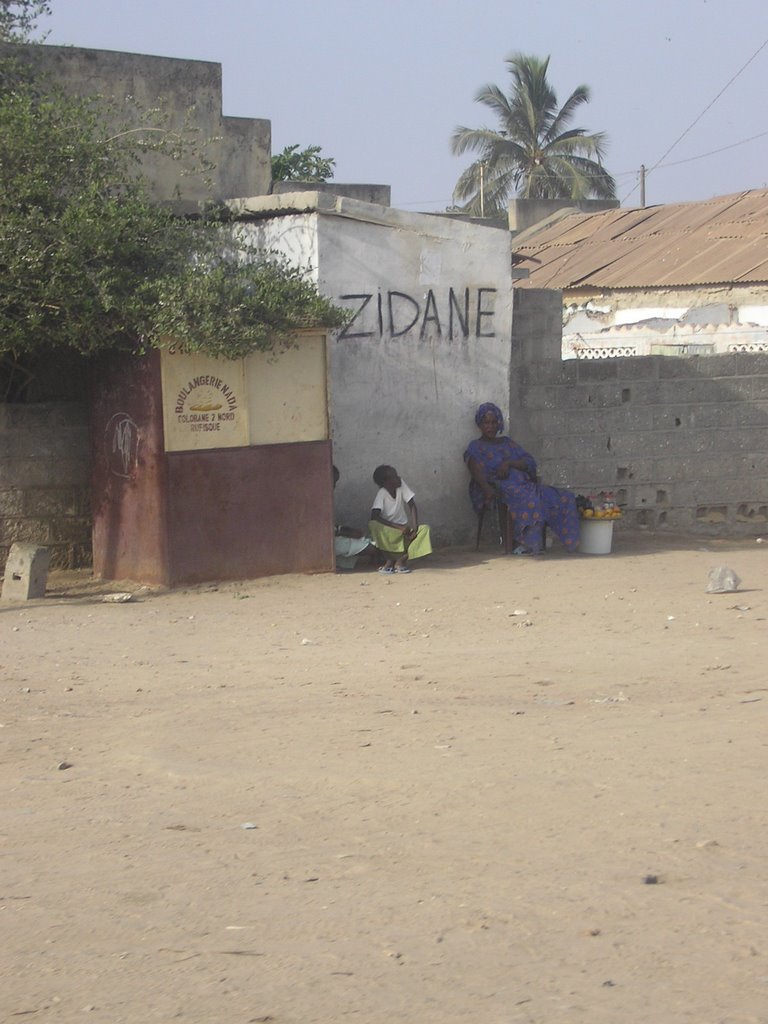
Football Fans
Sunday, August 06, 2006
Big Love
So one of the more interesting things I learned during my recent trip is that polygamy is alive and well in Senegal. Not that I have anything against polygamy necessarily, but it was just interesting being in a place that openly practiced it. I was told that Senegalese law allows for a man to have up to four wives. Aside from the fact that I don't understand why anyone would even want to have four wives, I'm very interested in understanding how the logistics of such a relationship would play out. I met a few married couples in Dakar, but unfortunately, I don't think I met any men that had multiple wives. I understand that the first wife is supreme over any subsequent wives, but beyond that, I don't know how the whole arrangement works. Do they all live together, or do they generally maintain separate residences and the man divides his time accordingly? Are all children equal, or does the preference given to the first wife extend to the children she bears as well? It seems to me that it would be a very complicated and very delicately balanced relationship, but it's likely that they've been practicing polygamy for centuries and have no trouble negotiating all of the potential pitfalls that would be common to novices.
One woman that I met there had been dating a married man for several years. After 9 years of what I would characterize as him stringing her along, she learned that he had made a pact with his wife to refrain from taking another wife despite the aspirations of the woman that I had met, who was hoping to become wife number 2. As the situation stood by the time I left, as relayed to me by my friend, the woman and the married man were actively trying to pursuade the wife to release the husband from his aggreement so that he could take a second wife. What seemed odd to me as a westerner, was not so much that the woman was willing to be wife number 2, but the fact that she was the one most actively pursuing that position. Although she was well aware that she would be playing second fiddle to his first wife for the rest of her life, she had decided that she wanted to be with this man and was determined to convince his wife to allow her into their family. The whole situation seems so opposed to our notions of feminism here in the west. There just seems like there is something inherently wrong with her pursuing such a position of inferiority. However, different cultures have very different rules and norms. Maybe from her point of view, asserting her desire to be with this particular man was her form of self-empowerment. Maybe it's not about the man at all. Maybe marriage to her is simply a tool to gain greater access in society so that she can more easily accomplish her goals in life. Or maybe not. Who knows. I just think it's all very interesting.
One woman that I met there had been dating a married man for several years. After 9 years of what I would characterize as him stringing her along, she learned that he had made a pact with his wife to refrain from taking another wife despite the aspirations of the woman that I had met, who was hoping to become wife number 2. As the situation stood by the time I left, as relayed to me by my friend, the woman and the married man were actively trying to pursuade the wife to release the husband from his aggreement so that he could take a second wife. What seemed odd to me as a westerner, was not so much that the woman was willing to be wife number 2, but the fact that she was the one most actively pursuing that position. Although she was well aware that she would be playing second fiddle to his first wife for the rest of her life, she had decided that she wanted to be with this man and was determined to convince his wife to allow her into their family. The whole situation seems so opposed to our notions of feminism here in the west. There just seems like there is something inherently wrong with her pursuing such a position of inferiority. However, different cultures have very different rules and norms. Maybe from her point of view, asserting her desire to be with this particular man was her form of self-empowerment. Maybe it's not about the man at all. Maybe marriage to her is simply a tool to gain greater access in society so that she can more easily accomplish her goals in life. Or maybe not. Who knows. I just think it's all very interesting.
Tuesday, July 11, 2006
Dakar: First Impressions
Here wr are: Day 5 of 35 days in Senegal. I'm having a great time so far. Although it may not have been the most financially responsible decision I've ever made in light of the fact that i won't have a job for the next 2 years while i'm in school, this was the perfect ime to come for several reasons. First I have a friend here. In a spectacular coincidence, I learned a few weeks ago that a friend from college not only just graduated from the grad program I'm about to enter, but also won the fellowship that i was granted back in May. As a result of the fellowship, she's interning at the US Embassy here in Dakar and has a whole house to herself in downtown Dakar curtousy of generous tax-paying Americans. So I've been staying with her this week. Having a place to stay has been great of course, but another great part is that she somehow knows so many people here. We've been taken around town and invited to eat in the homes of several Senegalese families just in the few days I've been here. It's been great. That's stuff that I would have not been able to tap into had I been here on my own, which was the original plan.
Secondly, this was the perfect time to come because I don't think I would have been able to appreciate it here had I come before now. Looking back on my time in Austria and China and even as recently as my trip to Japan this spring, i needed those experiences to get me ready for Africa, which is where I've been really wanting to go all along. I believe that some people are born ready to spend time in Africa, some are probably never ready to come to Africa, I just needed some time to learn how to really appreciate life outside of the US before I came. Otherwise, I probably wouldn't have enjoyed being here. But this is still the first week. Let's see how I feel in a month.
So enough about me. Let's talk about dakar. First, the Senegalese are beautiful. Of course, not everyone is gorgeous, but many many are. Both men and women alike. They tend to have tall, slender, naturally toned bodies with absolutley beautiful very dark skin. I find myself going off course following people walking down the street because they're so beautiful and I'm not ready to stop looking at them yet.
The food. The food is so good. The meals seem very simple (fish or chicken, vegetables and rice), but it is so good. Since it's right on the coast, there's an abundance of seafood, and I don't know how they cook it, but it's so very tasty. I just had a whole fish today for lunch and I think I may have another one tomorrow... or maybe even later tonight. This is food at a restaurant that's so good. When we go to someone's home, it's even better.
Contrary to my impressions beforehand, Dakar ain't cheap! Many things are pretty much on par with the US in terms of price. My meal today (fish, rice, a bottle of local beer) cost me about 10 or 11 dollars. The same meal at a comparable restaurant would've probably cost me about 15 or 16 in Baltimore and maybe 20 in San Francisco ( as an aside, SF is expensive, in my opinion). While it's cheaper than the US, it's really not all that cheap. I was expecting China prices, and I was clearly mistaken. Talking to one of my friend's (very wealthy) Senegalese friends, I also learned that real estate in Dakar is very expensive. Maybe more expensive than much of the US. Other things are really cheap, however. For example, my language class is only 200 dollars for 100 hours of instruction (i.e. 2 dollars an hour). The programs I was looking at in France wanted 230-250 dollars a week for about 20 hours of instruction. So some things here are rather pricey, while others are pretty cheap.
Not only is this my first time in Africa, but it's also my first time in a predominately Muslim country. Although I get the impression that Senegal is a rather secular Muslim country (more of what I imagine Turkey to be as opposed to my impression of Saudi Arabia), I find it all pretty interesting. I took the bus home after class today, and on the way home I saw the faithful flooding the streets and outdoor markets as the Grand Mosque emptied after, I presume, the conclusion of Friday afternoon prayers. There were men carrying prayer rugs and beads everywhere. Some were adorned in traditional dress while many just had on a t-shirt and pants. It was pretty cool.
Dakar, not unexpectedly, is very homogenous. I'm sure there are different tribes that make up the population here, but with my untrained american eyes, I just see a lot of black people. I mean, that's great and part of the reason i came here, but still, it's not very unlike Tokyo or Beijing in that regard. Interestingly enough, also not unlike Beijing and Tokyo, the Senegalese can pick me out of a crowd in an instant. Eventhough I feel like I blend in here a lot more than i ever could in Beijing or Tokyo, i'm as much a foreigner to the Senegalese as I was to the Chinese or Japanese. Of course the fact that I don't speak french is a dead giveaway, but i don't even have to open my mouth for people selling stuff on the street to approach me with what little English they have.
Just a few moments ago, I a Senegalese woman tried to pick me up in the internet cafe. Although she broke the ice asking me whether I worked here, she knew good and well that I didn't work here the moment she laid eyes on me. In China there was a very interesting dynamic between Chinese women and foreign men. Many women in China saw the potential to lure a (presumed) wealthy foreigner (which i imagine is common in many developing countries). I'm interested in seeing whether it will be a similar dynamic here in Senegal.
So that's my take on Dakar so far. One other activity of interest that I've taken part in is a trip to the Pink Lake a few days ago. It's literally pink and hella salty! Apparently, there are minerals in the water that provide favorable conditions to a certain type of algae that glistens pink when the sun's rays hit it. But the other cool part is that it's so unbelievably salty that you literally can't help but float. You can't really even swim because almost your entire body is floating on top of the water. It's pretty cool, but if your unfortunate enough to get some water in your mouth or, even worse, in your eyes, the whole experience instantly becomes a lot less enjoyable.
Secondly, this was the perfect time to come because I don't think I would have been able to appreciate it here had I come before now. Looking back on my time in Austria and China and even as recently as my trip to Japan this spring, i needed those experiences to get me ready for Africa, which is where I've been really wanting to go all along. I believe that some people are born ready to spend time in Africa, some are probably never ready to come to Africa, I just needed some time to learn how to really appreciate life outside of the US before I came. Otherwise, I probably wouldn't have enjoyed being here. But this is still the first week. Let's see how I feel in a month.
So enough about me. Let's talk about dakar. First, the Senegalese are beautiful. Of course, not everyone is gorgeous, but many many are. Both men and women alike. They tend to have tall, slender, naturally toned bodies with absolutley beautiful very dark skin. I find myself going off course following people walking down the street because they're so beautiful and I'm not ready to stop looking at them yet.
The food. The food is so good. The meals seem very simple (fish or chicken, vegetables and rice), but it is so good. Since it's right on the coast, there's an abundance of seafood, and I don't know how they cook it, but it's so very tasty. I just had a whole fish today for lunch and I think I may have another one tomorrow... or maybe even later tonight. This is food at a restaurant that's so good. When we go to someone's home, it's even better.
Contrary to my impressions beforehand, Dakar ain't cheap! Many things are pretty much on par with the US in terms of price. My meal today (fish, rice, a bottle of local beer) cost me about 10 or 11 dollars. The same meal at a comparable restaurant would've probably cost me about 15 or 16 in Baltimore and maybe 20 in San Francisco ( as an aside, SF is expensive, in my opinion). While it's cheaper than the US, it's really not all that cheap. I was expecting China prices, and I was clearly mistaken. Talking to one of my friend's (very wealthy) Senegalese friends, I also learned that real estate in Dakar is very expensive. Maybe more expensive than much of the US. Other things are really cheap, however. For example, my language class is only 200 dollars for 100 hours of instruction (i.e. 2 dollars an hour). The programs I was looking at in France wanted 230-250 dollars a week for about 20 hours of instruction. So some things here are rather pricey, while others are pretty cheap.
Not only is this my first time in Africa, but it's also my first time in a predominately Muslim country. Although I get the impression that Senegal is a rather secular Muslim country (more of what I imagine Turkey to be as opposed to my impression of Saudi Arabia), I find it all pretty interesting. I took the bus home after class today, and on the way home I saw the faithful flooding the streets and outdoor markets as the Grand Mosque emptied after, I presume, the conclusion of Friday afternoon prayers. There were men carrying prayer rugs and beads everywhere. Some were adorned in traditional dress while many just had on a t-shirt and pants. It was pretty cool.
Dakar, not unexpectedly, is very homogenous. I'm sure there are different tribes that make up the population here, but with my untrained american eyes, I just see a lot of black people. I mean, that's great and part of the reason i came here, but still, it's not very unlike Tokyo or Beijing in that regard. Interestingly enough, also not unlike Beijing and Tokyo, the Senegalese can pick me out of a crowd in an instant. Eventhough I feel like I blend in here a lot more than i ever could in Beijing or Tokyo, i'm as much a foreigner to the Senegalese as I was to the Chinese or Japanese. Of course the fact that I don't speak french is a dead giveaway, but i don't even have to open my mouth for people selling stuff on the street to approach me with what little English they have.
Just a few moments ago, I a Senegalese woman tried to pick me up in the internet cafe. Although she broke the ice asking me whether I worked here, she knew good and well that I didn't work here the moment she laid eyes on me. In China there was a very interesting dynamic between Chinese women and foreign men. Many women in China saw the potential to lure a (presumed) wealthy foreigner (which i imagine is common in many developing countries). I'm interested in seeing whether it will be a similar dynamic here in Senegal.
So that's my take on Dakar so far. One other activity of interest that I've taken part in is a trip to the Pink Lake a few days ago. It's literally pink and hella salty! Apparently, there are minerals in the water that provide favorable conditions to a certain type of algae that glistens pink when the sun's rays hit it. But the other cool part is that it's so unbelievably salty that you literally can't help but float. You can't really even swim because almost your entire body is floating on top of the water. It's pretty cool, but if your unfortunate enough to get some water in your mouth or, even worse, in your eyes, the whole experience instantly becomes a lot less enjoyable.
Friday, June 30, 2006
A Bientot!
I think I'll be taking a bit of a hiatus from Quarterlife Crossroads starting on Sunday. Before heading off to graduate school in the fall, I'm taking the next 5 weeks or so to learn French in Dakar, Senegal. I have no idea of how my internet access will be during that time. But, rest assured, I'll be recounting my adventures and posting photos upon my return to the States in early August.
Believe the Hype
I just finished reading Life of Pi by Yann Martel. Everyone was right: it's an excellent book. One reviewer goes so far as to make the lofty claim that it will make you "believe in God". I don't know about all that, but it is a damn good story. Like I mentioned in my previous entry, I am one of the few people out there who hadn't already read this book, but for the handful of y'all out there who haven't read it, I suggest picking it up.
The story opens with the very unassuming tale of a god-fearing boy growing up in India raised by zookeeping parents. When the family embarks on a journey to Canada by boat with several of their animals, however, things get a little out of the ordinary. Without providing any more detail than you would get from the outside of the book jacket, the ship sinks and the boy finds himself alone on a life boat with a 450-pound Bengal tiger floating somewhere in the Pacific.
Martel is an excellent story teller. He spends about two-thirds of the novel in the exact same setting on the life boat, with the exact same two characters (only one of whom actually speaks) and somehow tells a riveting story set in a seemingly mundane environment. While on the one hand, I was eager to learn what would happen next, on the other hand, I didn't want the book to end.
Anyone's who's read it, please do drop me a line. After briefly discussing the "believing in God aspect" of the book over a beer last night, my friend Mark made a very interesting point. I don't want to make the point now because I don't want to spoil the ending for anyone.
In a rare move away from contemporary fiction, for my next book, I've chosen The End of Poverty by Jeffrey Sachs. Although I feel that Professor Sachs could have chosen a more compelling figure to write the forward than Bono, Sachs is one of the most interesting people in development economics today. As the head of Columbia University's Earth Institute, professor at Columbia's School of International and Public Affairs, and Kofi Annan's appointee to spearhead the United Nation's Millenium Goals Project, Sachs is definitely an intellectual force to be reckoned with. I just picked up the book this evening. I'm about 20 pages into it, and already I'm a big fan. I'm looking foward to getting deeper into it and also for the opportunity to discuss some of the major themes with Professor Sachs when I start my Masters of International Affiars program at Columbia in the fall.
The story opens with the very unassuming tale of a god-fearing boy growing up in India raised by zookeeping parents. When the family embarks on a journey to Canada by boat with several of their animals, however, things get a little out of the ordinary. Without providing any more detail than you would get from the outside of the book jacket, the ship sinks and the boy finds himself alone on a life boat with a 450-pound Bengal tiger floating somewhere in the Pacific.
Martel is an excellent story teller. He spends about two-thirds of the novel in the exact same setting on the life boat, with the exact same two characters (only one of whom actually speaks) and somehow tells a riveting story set in a seemingly mundane environment. While on the one hand, I was eager to learn what would happen next, on the other hand, I didn't want the book to end.
Anyone's who's read it, please do drop me a line. After briefly discussing the "believing in God aspect" of the book over a beer last night, my friend Mark made a very interesting point. I don't want to make the point now because I don't want to spoil the ending for anyone.
In a rare move away from contemporary fiction, for my next book, I've chosen The End of Poverty by Jeffrey Sachs. Although I feel that Professor Sachs could have chosen a more compelling figure to write the forward than Bono, Sachs is one of the most interesting people in development economics today. As the head of Columbia University's Earth Institute, professor at Columbia's School of International and Public Affairs, and Kofi Annan's appointee to spearhead the United Nation's Millenium Goals Project, Sachs is definitely an intellectual force to be reckoned with. I just picked up the book this evening. I'm about 20 pages into it, and already I'm a big fan. I'm looking foward to getting deeper into it and also for the opportunity to discuss some of the major themes with Professor Sachs when I start my Masters of International Affiars program at Columbia in the fall.
Friday, June 23, 2006
John Henry Days
I recently finished the book John Henry Days by Colson Whitehead. I really liked it. It's very well written. It's primarily about a fairly young discontented black journalist from New York City who is sent to cover the weekend celebration surrounding the unveiling of a new John Henry stamp by the post office in John Henry's hometown in West Virginia. That's the main premise of the novel, and while that story on its own is interesting, Whitehead takes the book in so many different directions. Not only does he tell the story of the main character, but he also gives us a glimpse into the life of John Henry in the days and years leading up to his ill-fated race with a steam-powered version of himself. He also tells the tales of many of the characters that his main character meets during his weekend in West Virginia. All in first person. The novel jumps around a lot, but it's never difficult to follow and it's always entertaining.
I like reading fiction by people I feel are smarter than I. There's a certain style of writing that I particularly enjoy. I've read many novels that I would put in this category - most notably Infinite Jest by David Foster Wallace and Another Country by James Baldwin - but I find it most rewarding when I can find that style of writing in a modern African-American author. In an earlier entry, I've discussed the difficulty I have in finding quality contemporary African-American fiction, so on the rare occasion that I do find it, I feel the need to share the news with as many people as I can.
I'm looking forward to reading his first novel, The Intuitionist.
Currently I'm about halfway through Life of Pi by Yann Martel. In case there are a few people out there who haven't read this book already (I honestly think that I'm the only person on earth who hasn't read this book already), it's been a very good read so far.
I like reading fiction by people I feel are smarter than I. There's a certain style of writing that I particularly enjoy. I've read many novels that I would put in this category - most notably Infinite Jest by David Foster Wallace and Another Country by James Baldwin - but I find it most rewarding when I can find that style of writing in a modern African-American author. In an earlier entry, I've discussed the difficulty I have in finding quality contemporary African-American fiction, so on the rare occasion that I do find it, I feel the need to share the news with as many people as I can.
I'm looking forward to reading his first novel, The Intuitionist.
Currently I'm about halfway through Life of Pi by Yann Martel. In case there are a few people out there who haven't read this book already (I honestly think that I'm the only person on earth who hasn't read this book already), it's been a very good read so far.
Bitter Sweet
Yesterday started off with a sad, but not totally unexpected, morning. The United States is out of the World Cup, falling to Ghana 2:1. After their horrible show against the Czech Republic and their mediocre performance against the Italians, I don't think anyone was terribly surprised that the US didn't make it to the second round. After Ghana beat the Czechs 2:0 last week, the writing was pretty much on the wall. At least the US didn't go home scoreless. The point the gained during the match with Italy in which they tied 1:1, was scored for them by an Italian player. So the match against Ghana was the first, and only, goal scored by an American during the tournement. However, that proved to be insufficient because the Ghanaians went on to score two goals during the course of the game.
To the US's credit the foul called against Onyewu in the box that resulted in a penalty kick for Ghana, at which time they scored their second goal, was a bad call. There was clearly no foul. But it really wouldn't have mattered either way. The US needed to win this game to make it to the second round. If it weren't for that penalty kick, they would have only tied. So either way, the Americans would've been sent home.
The title of this post is Bitter Sweet because although I'm disappointed that the US didn't make it out of the group, I'm very excited that Ghana did. They're the only African team to make it out of the group stage. I was rooting first and foremost for the Americans coming into the tournement, but secondly, I've been rooting for the four sub-saharan African teams to suceed. Ghana is the only one to do so. Unfortunately, however, their first match out of the group stage is against reigning champs Brazil, but you never know. I don't think many people expected Ghana to make it this far. Maybe they have one more upset still in them.
To the US's credit the foul called against Onyewu in the box that resulted in a penalty kick for Ghana, at which time they scored their second goal, was a bad call. There was clearly no foul. But it really wouldn't have mattered either way. The US needed to win this game to make it to the second round. If it weren't for that penalty kick, they would have only tied. So either way, the Americans would've been sent home.
The title of this post is Bitter Sweet because although I'm disappointed that the US didn't make it out of the group, I'm very excited that Ghana did. They're the only African team to make it out of the group stage. I was rooting first and foremost for the Americans coming into the tournement, but secondly, I've been rooting for the four sub-saharan African teams to suceed. Ghana is the only one to do so. Unfortunately, however, their first match out of the group stage is against reigning champs Brazil, but you never know. I don't think many people expected Ghana to make it this far. Maybe they have one more upset still in them.
Tuesday, June 13, 2006
World Cup Fever
Another four years have past and it's finally time for another World Cup Tournement. I love international soccer! I should be in Germany right now taking in all of the festivities first hand, but, alas, finances and circumstances weren't on my side. Maybe South Africa in 2010 will prove more attainable. Nevertheless, I am thoroughly enjoying catching the mathches on the tele, despite the fact that the team I root for always ends up losing.
As a red-blooded American, I'm of course rooting for US all the way. I'm also pulling for the African teams to have a good showing this year. So far, I've seen the Argentina -- Cote d'Ivoire match in which Cote d'Ivoire lost 2-1. The Ivorians did manage to score a goal to tie the game in the last 10 or 15 minutes of play, which made things a lot more exciting for a little while. However, the Argentines went on to win. This afternoon the Ghanaians lost to the Italians 2-0. I only saw the first half of the game and although Ghana went on to lose the game, I thought that they were playing a good game. They had several shots on goal. They were able to get inside the box on several occasions, but had difficulty in the final execution, which is all that really matters in the end. But a pretty good showing overall against Italy that's known for it's defense. The Americans, on the other hand, are another story. They really sucked it up today. They were terrible, losing to the Czech Republic 3-0. The whole team only had like 4 or 5 shots on goal the entire game. Tomas Rosicky, who scored 2 of Czech's goals, had three shots on goal all by himself! I really need to have a talk with the guy that came up with the model that ranked the US at number 5 in the world coming into the competition. The US is really going to have to step it up or else they won't even have a chance against Italy on Saturday. By the looks of how poorly the US played today and how well the Ghanaians played during the first half of their game, I'd have to say that the US may even have a tough time taking on Ghana. To their credit, however, Claudio Reyna of the US was agonizingly close to scoring a goal in the first half. It was literally off by an inch or two, and the play leading up to the shot was beautiful. They had some really good team work moving the ball up field and the shot was set up perfectly, but no matter how close it was and how beautifully it was set up, the ball still didn't go in the goal. And even if it had, that was the only well executed play of the game. Had they made that shot, they still would have lost by 2 points.
As a red-blooded American, I'm of course rooting for US all the way. I'm also pulling for the African teams to have a good showing this year. So far, I've seen the Argentina -- Cote d'Ivoire match in which Cote d'Ivoire lost 2-1. The Ivorians did manage to score a goal to tie the game in the last 10 or 15 minutes of play, which made things a lot more exciting for a little while. However, the Argentines went on to win. This afternoon the Ghanaians lost to the Italians 2-0. I only saw the first half of the game and although Ghana went on to lose the game, I thought that they were playing a good game. They had several shots on goal. They were able to get inside the box on several occasions, but had difficulty in the final execution, which is all that really matters in the end. But a pretty good showing overall against Italy that's known for it's defense. The Americans, on the other hand, are another story. They really sucked it up today. They were terrible, losing to the Czech Republic 3-0. The whole team only had like 4 or 5 shots on goal the entire game. Tomas Rosicky, who scored 2 of Czech's goals, had three shots on goal all by himself! I really need to have a talk with the guy that came up with the model that ranked the US at number 5 in the world coming into the competition. The US is really going to have to step it up or else they won't even have a chance against Italy on Saturday. By the looks of how poorly the US played today and how well the Ghanaians played during the first half of their game, I'd have to say that the US may even have a tough time taking on Ghana. To their credit, however, Claudio Reyna of the US was agonizingly close to scoring a goal in the first half. It was literally off by an inch or two, and the play leading up to the shot was beautiful. They had some really good team work moving the ball up field and the shot was set up perfectly, but no matter how close it was and how beautifully it was set up, the ball still didn't go in the goal. And even if it had, that was the only well executed play of the game. Had they made that shot, they still would have lost by 2 points.
Land of the Rising Sun
Here are just a few shots from my recent trip to Japan.
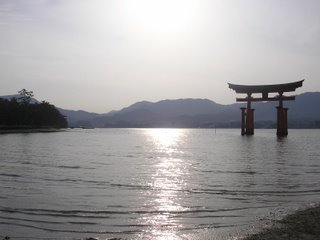
Miyajima
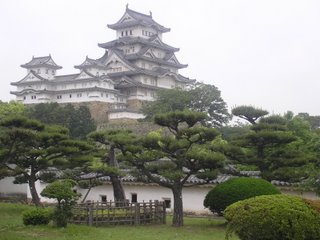
Himeji Castle

Carp and Latern
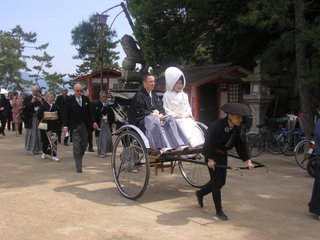
Just Married
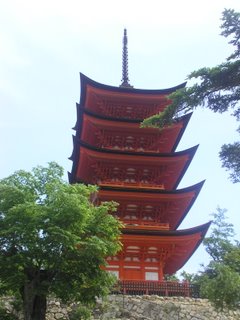
Five-Tier Pagoda
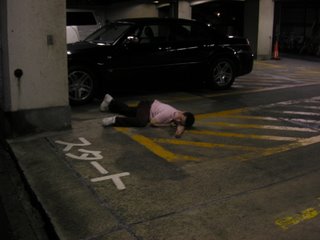
A Friday Night Gone Horribly Wrong
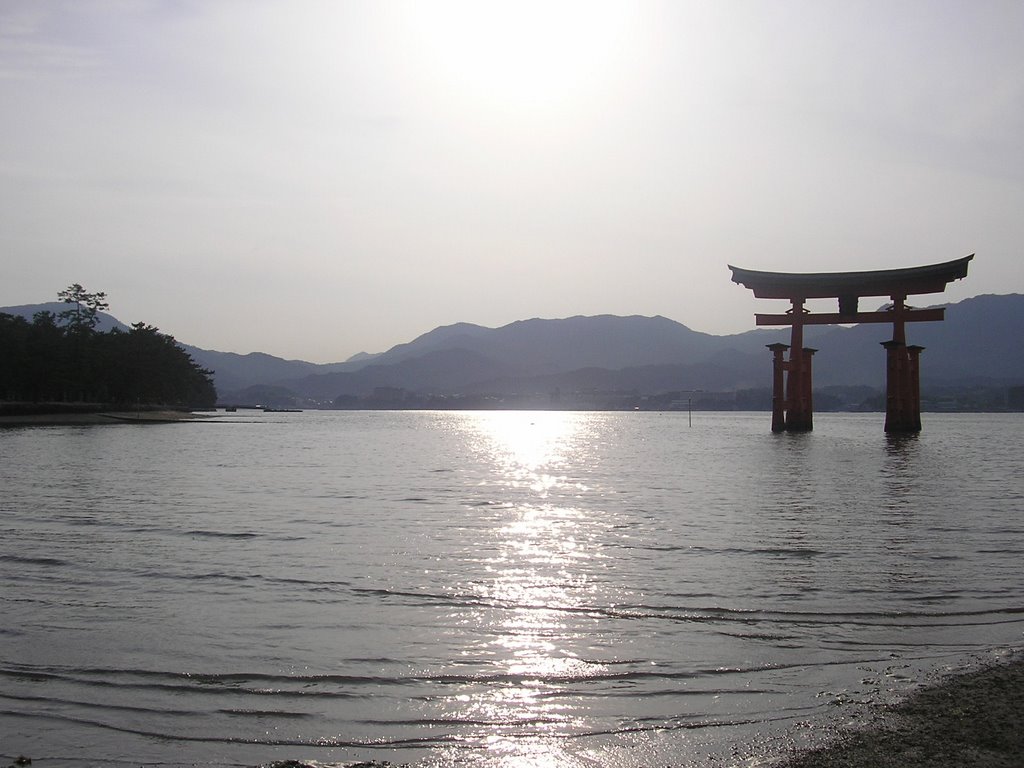
Miyajima
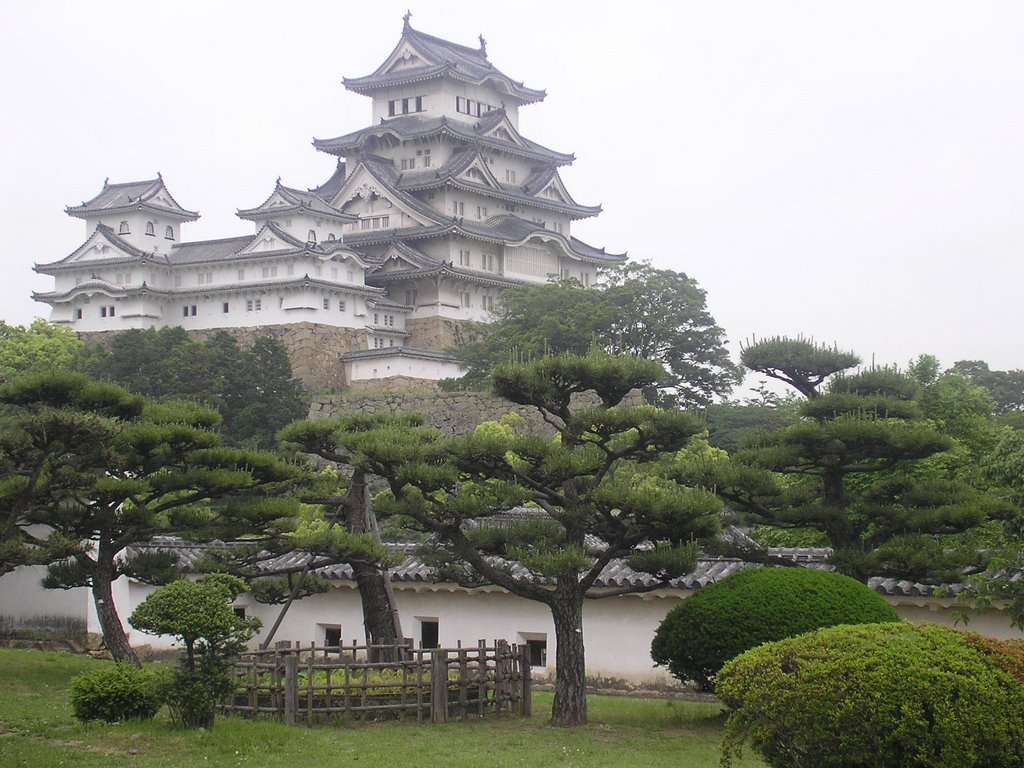
Himeji Castle
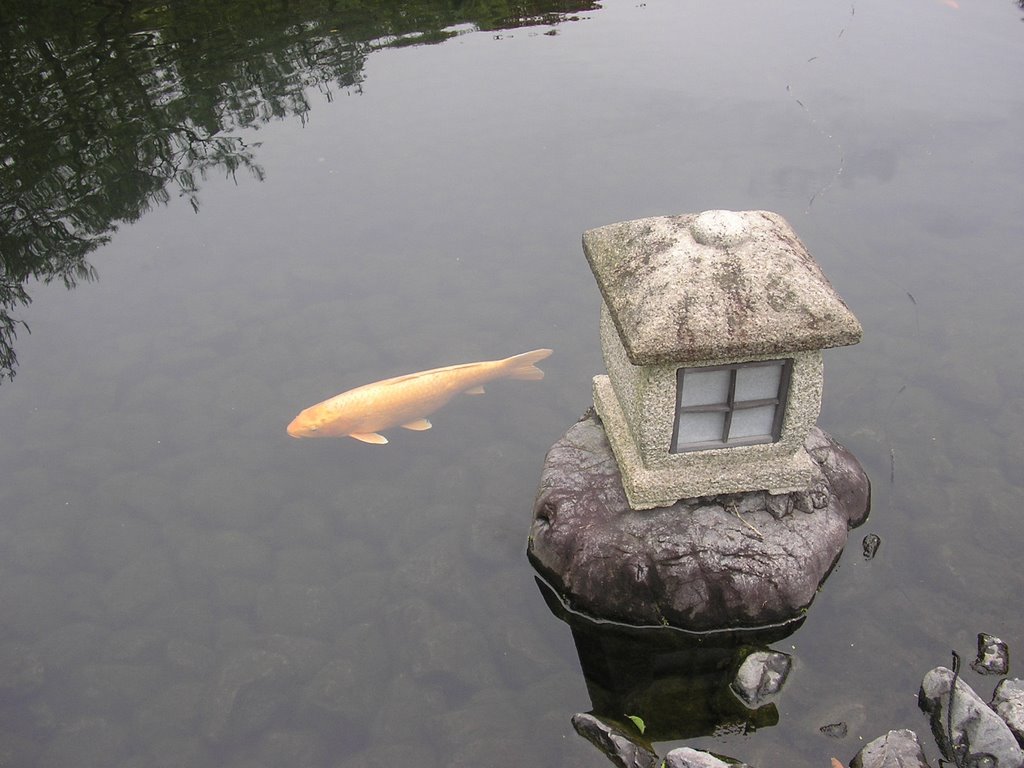
Carp and Latern
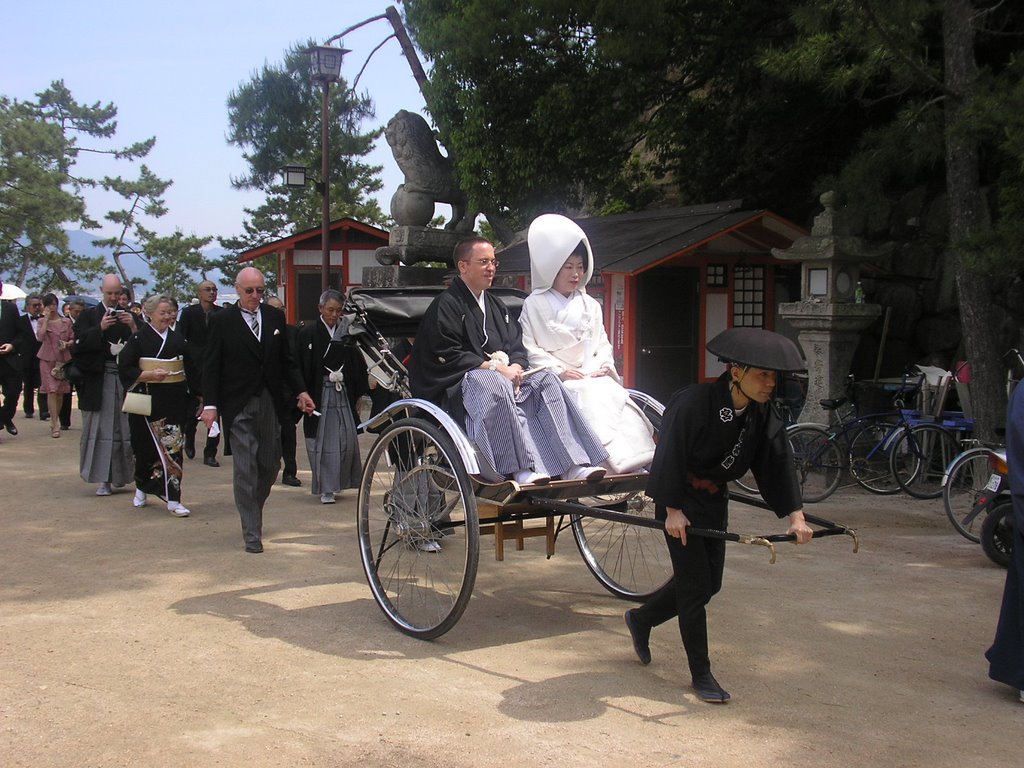
Just Married
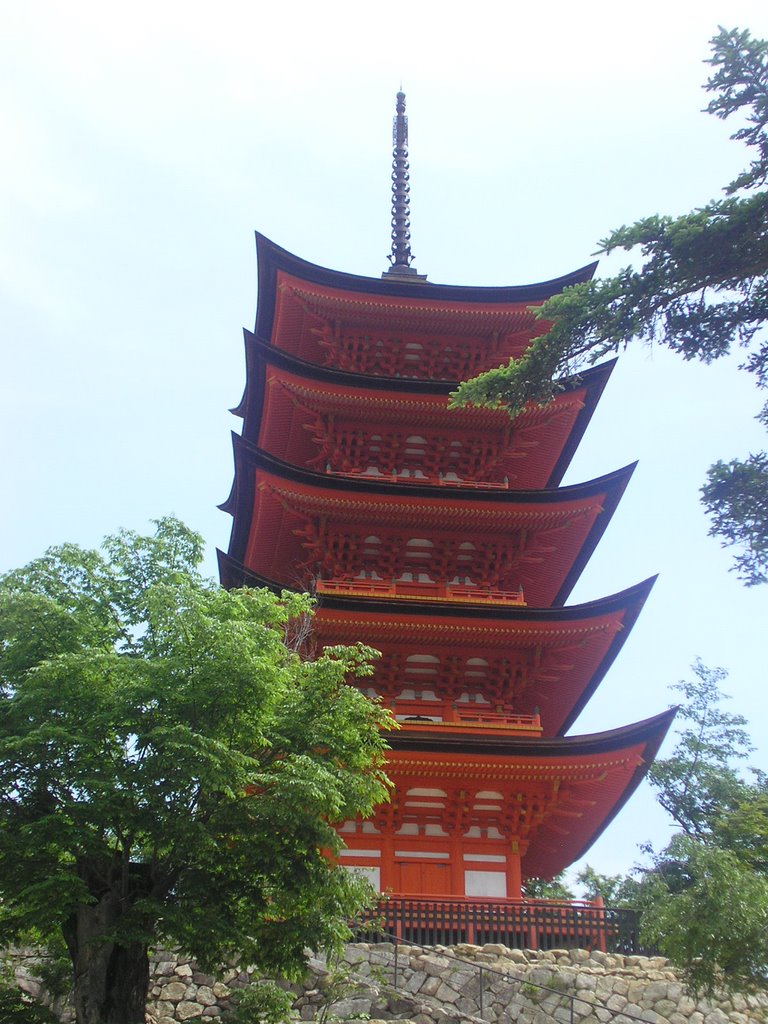
Five-Tier Pagoda

A Friday Night Gone Horribly Wrong
Saturday, May 27, 2006
Buy me some peanuts and... ramen?
Baseball may be America's favorite pastime, but we got nothing on the Japanese.
I was just in Hiroshima the other day, where I was able to catch a baseball game between the Hiroshima Carp and the Blue Buffalo from some undetermined city in Japan. The Japanese really love themselves some baseball. Not speaking any Japanese, I found myself sitting in the section of the opposing team (which crushed the hometeam by like 7 - 2). It was awesome! The Japanese take baseball very seriously. I don't think I even watched much of the game. I was too busy looking at all of the crazy fans in the bleachers.
Baseball in America is a very subdued spectator sport. There may be a few profanities thrown at the umpire for making a bad call every once in a while, but that's pretty much the extent of it. It's a very different story in Japan. Not only are the crowds yelling and chanting practically the entire game, but there are also huge banners and flags being waved, drums being beat upon, and bands of trumpeteers making the rounds. With a few opening lines, the band leader gets up, signals the drums and trumpets to start playing and the entire crowd joins in on the fight song chosen from their seemingly infinite repetoire. It's pretty cool. And pretty insane. While I had absolutely no idea what the people were chanting, I joined in as much as I could and I made a couple friends in the process. Although neither of us could speak the other's language, the fact that I was clearly cheering on their team garnered me a couple of hi-fives at key points during the game. It was fun. And for only 15 bucks, it was one of the few things in Japan that's actually reasonably priced.
I was just in Hiroshima the other day, where I was able to catch a baseball game between the Hiroshima Carp and the Blue Buffalo from some undetermined city in Japan. The Japanese really love themselves some baseball. Not speaking any Japanese, I found myself sitting in the section of the opposing team (which crushed the hometeam by like 7 - 2). It was awesome! The Japanese take baseball very seriously. I don't think I even watched much of the game. I was too busy looking at all of the crazy fans in the bleachers.
Baseball in America is a very subdued spectator sport. There may be a few profanities thrown at the umpire for making a bad call every once in a while, but that's pretty much the extent of it. It's a very different story in Japan. Not only are the crowds yelling and chanting practically the entire game, but there are also huge banners and flags being waved, drums being beat upon, and bands of trumpeteers making the rounds. With a few opening lines, the band leader gets up, signals the drums and trumpets to start playing and the entire crowd joins in on the fight song chosen from their seemingly infinite repetoire. It's pretty cool. And pretty insane. While I had absolutely no idea what the people were chanting, I joined in as much as I could and I made a couple friends in the process. Although neither of us could speak the other's language, the fact that I was clearly cheering on their team garnered me a couple of hi-fives at key points during the game. It was fun. And for only 15 bucks, it was one of the few things in Japan that's actually reasonably priced.
Friday, May 19, 2006
I'm Lovin' It!
I'm a bit of a traveller. I can't seem to stay in one place for very long. Over the years, I've developed a list of a few things that I like to do whenever I travel to a foreign country for the first time. Despite the look of disgust I get from my friends when I tell them this, whenever I go to a new country, I always make it a point to go to McDonald's at least once. While most people try to stay as far away from Micky D's as possible, especially when abroad, the Golden Arches are like a siren in the distance beckoning me to come closer. This is true for a couple of reasons. First, I love how McDonald's manages to adapt to whatever environment it's in. It's like some kind of mutating bacteria slowly encompassing the entire globe. There's always the basic stuff in every McDonald's anywhere in the world - Big Mac, Filet 'o Fish, Quarter Pounder w/ cheese - but there are also a few other things specific only to that country. For example, McDo in France serves yogurt and a croissant with breakfast. In addition to the traditional apple, MaiDengLao in China offers Pineapple and Taro Root pies - neither of which I actually recommend. I love seeing how McDonald's tries to adapt to the local tastes while keeping it real for the visiting Americans who are just out for a taste of home.
Secondly, and most importantly, I love visiting McDonald's abroad for the apple pie. Unlike in the US, which has somehow successfully blamed the fast food industry for it's chronic obesity, it's been my experience that you can still get the fried apple pie in every McDonald's abroad, as opposed to the baked version available in the US. Apple pie isn't supposed to be healthy. It's just supposed to taste good. By choosing to only bake their pies, the US stores have successfully put a desert on the market that is neither good for you, nor tastes good. I don't see the point.
So this entry is coming at you all from my friend's apartment in Tokyo, where I had the pleasure today to experience one of those beautifully crispy and greasy and fatty deep-fried apple pies. Mmmmmm.... just like Mom used to make.
Secondly, and most importantly, I love visiting McDonald's abroad for the apple pie. Unlike in the US, which has somehow successfully blamed the fast food industry for it's chronic obesity, it's been my experience that you can still get the fried apple pie in every McDonald's abroad, as opposed to the baked version available in the US. Apple pie isn't supposed to be healthy. It's just supposed to taste good. By choosing to only bake their pies, the US stores have successfully put a desert on the market that is neither good for you, nor tastes good. I don't see the point.
So this entry is coming at you all from my friend's apartment in Tokyo, where I had the pleasure today to experience one of those beautifully crispy and greasy and fatty deep-fried apple pies. Mmmmmm.... just like Mom used to make.
Monday, April 10, 2006
Paradise Now
Saw a good movie last night: Paradise Now. I thought it was a great movie for several reasons. First, I found the premise and viewpoint of the story very interesting. Without giving away more than you would get from the outside of your Netflix sleeve, the story centers around two Palestinian men chosen to be suicide bombers in Tel Aviv. As an American, until very recently (I’d say the last few years), we were very rarely exposed to the Israeli-Palestinian conflict from the viewpoint of the Palestinians. All of our media directed our attention towards Israel as the victim, and rarely – as conveyed in the movie – towards Israel as the oppressor. I feel that bias began to shift slightly in recent years, but I don’t remember any reports of the plight of the Palestinians even as recently as 4 or 5 years ago. This movie was captivating partially due to the fact that it was set almost exclusively in the West Bank and the Israeli perspective never once came into play.
The second reason why I thought that this was such a great movie was because it did an excellent job of humanizing the characters. The two men weren’t simply suicide bombers. They were sons, and brothers, and friends, and auto-mechanics, and dreamers, and believers. They hadn’t been captured, brainwashed and coerced into carrying out this mission. They accepted the mission willingly. We saw a glimpse of how their lives are and had been on the West Bank: lives that caused them to believe in the mission they were on the verge of executing.
Furthermore, I felt that there was no judgment made. The film followed two men during the course of two days in their lives. There as no commentary on the paths that each chose. There was merely the depiction of those paths and a look into some of the events that led them to where they ultimately found themselves at the end of the film. Many people on both sides of the conflict feel very passionately about their position, and it was refreshing to see one side of the issue without the usual biased critique built in.
If anyone else has had the opportunity to check out this film, I’d love to read your comments.
The second reason why I thought that this was such a great movie was because it did an excellent job of humanizing the characters. The two men weren’t simply suicide bombers. They were sons, and brothers, and friends, and auto-mechanics, and dreamers, and believers. They hadn’t been captured, brainwashed and coerced into carrying out this mission. They accepted the mission willingly. We saw a glimpse of how their lives are and had been on the West Bank: lives that caused them to believe in the mission they were on the verge of executing.
Furthermore, I felt that there was no judgment made. The film followed two men during the course of two days in their lives. There as no commentary on the paths that each chose. There was merely the depiction of those paths and a look into some of the events that led them to where they ultimately found themselves at the end of the film. Many people on both sides of the conflict feel very passionately about their position, and it was refreshing to see one side of the issue without the usual biased critique built in.
If anyone else has had the opportunity to check out this film, I’d love to read your comments.
Saturday, April 01, 2006
Half Moon Bay
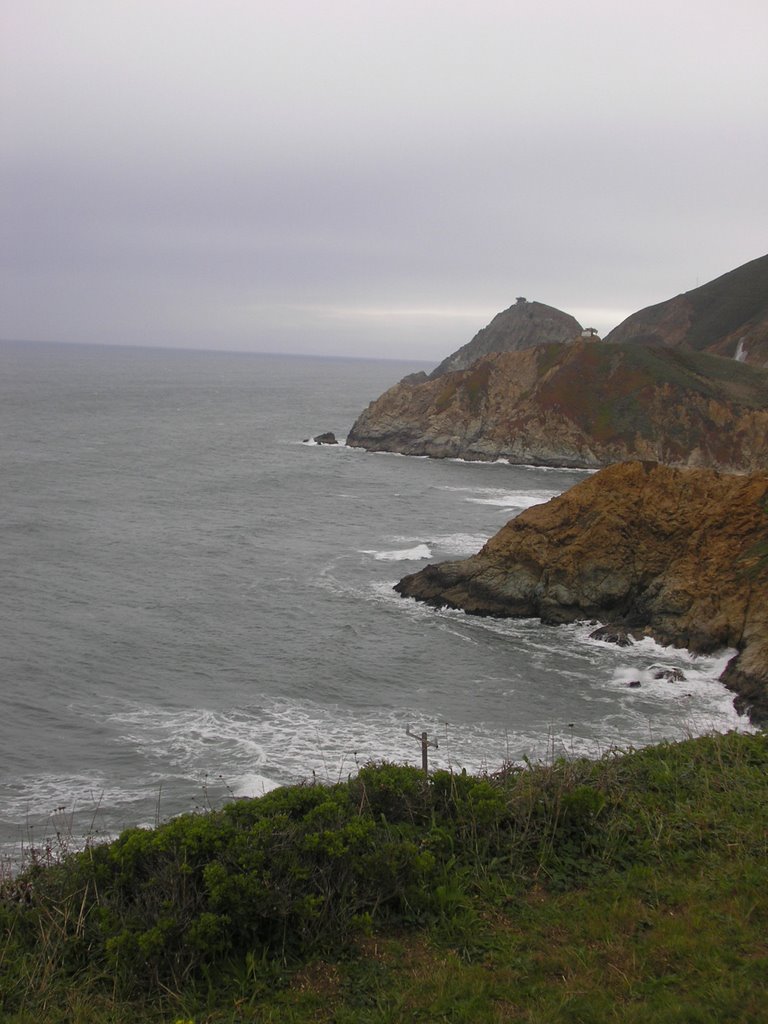
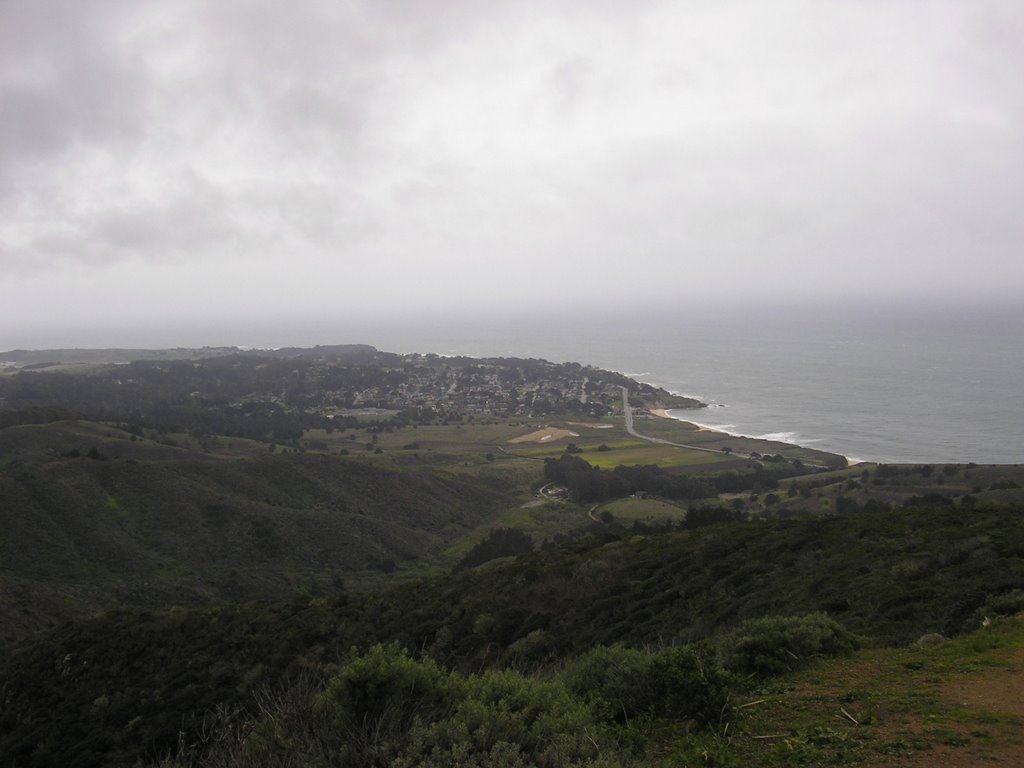
My job has been really getting on my nerves the last couple of weeks, so I figured after two weeks of 10.5 hour days, I deserved a break. I decided to call in sick yesterday and go hiking, which was so much better than going to work. I drove down to Half Moon Bay, which is quaint little town on the coast about a 40-minute drive south of San Francisco. I had never been there before, but I figured there would be some good hiking around there. I stopped in the visitor bureau for some advice. The woman behind the desk asked me whether I was looking for some "serious hiking", with much gravity in her voice. Not really knowing how "serious" a hike this would be but also not wanting to look like a punk, I said yes and she directed me to a place about 8 miles north of Half Moon Bay.
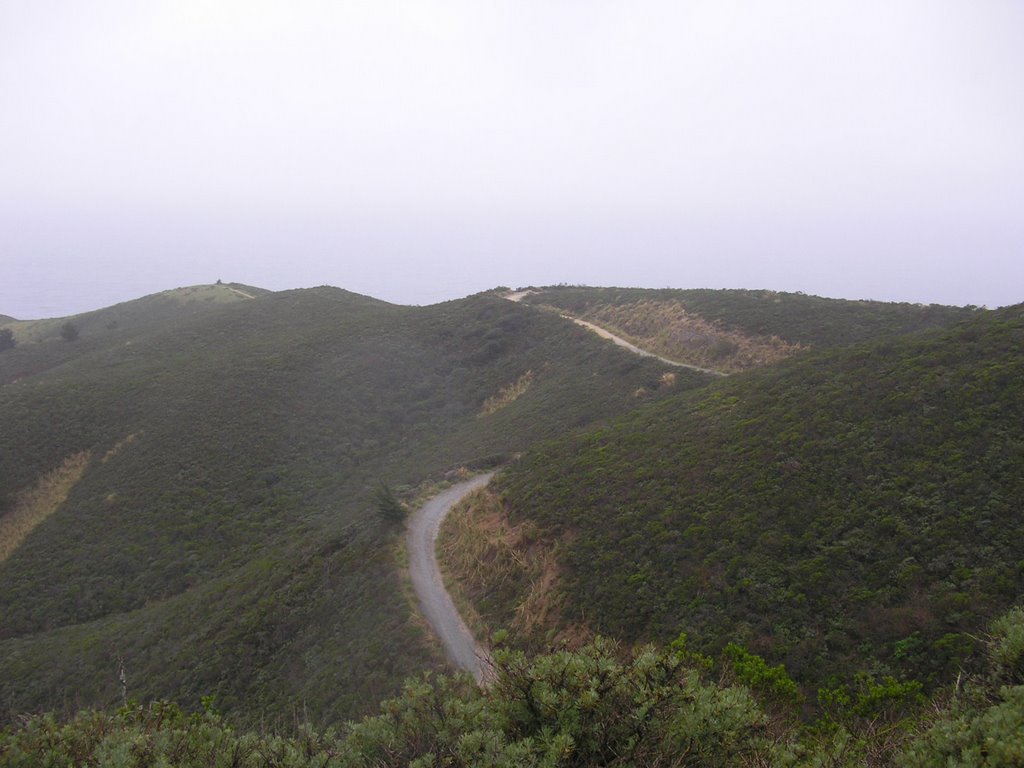
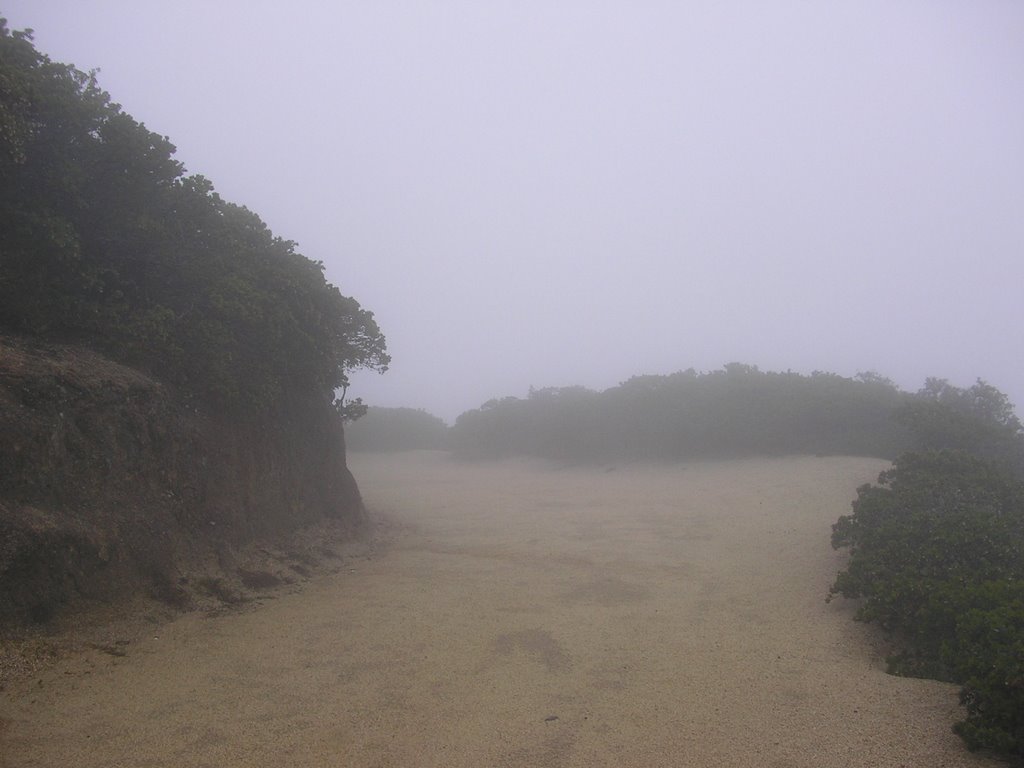
The trail basically meandered up the side of a mountain. Well, I don't think it would qualify as a mountain, but it was definitely much bigger than a hill. The visitors’ center lady said it would take about 2 hours to make it to the top. It was awesome. For all of you out there in Northern California, you know that it's been raining pretty much non-stop for the last month, but luckily it was pretty dry the first half of yesterday. When I parked the car at the foot of the trail, I looked up and saw some clouds looming up above, but there was still no rain. About an hour into the hike, I realized that I was actually inside the cloud that I was looking at from down below. It was pretty cool. I hiked onward for another half an hour or so, but as I walked, the conditions were becoming less and less hospitable as the cloud prepared for the torrential downpour that was to take place in about a half an hour's time. I turned around and started my way back down the trail because with all of the wind and hail, the hike wasn't quite as much fun anymore. But I must say, it was very cool being inside a cloud right before it started raining.
Not wanting to drive back to San Francisco in such heavy rain, I stopped at a great restaurant in downtown Half Moon Bay called the Half Moon Bay Inn. Their apple cobbler with butter pecan sorbet was out of control. I definitely recommend it. Then I went to Obester Winery for some wine tasting. This place, however, I do not recommend. The whites were terrible. I actually just skipped two of them because I couldn't handle it. The reds were slightly better, but only slightly. Eventhough you have to drive right past the place on the way back to the 280 back to San Francisco, it's not worth stopping in. It was that bad.
Here are a few shots from my adventure:


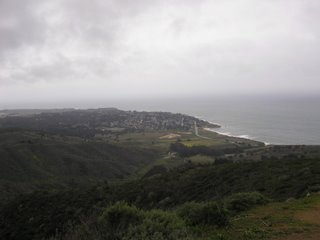

The trail basically meandered up the side of a mountain. Well, I don't think it would qualify as a mountain, but it was definitely much bigger than a hill. The visitors’ center lady said it would take about 2 hours to make it to the top. It was awesome. For all of you out there in Northern California, you know that it's been raining pretty much non-stop for the last month, but luckily it was pretty dry the first half of yesterday. When I parked the car at the foot of the trail, I looked up and saw some clouds looming up above, but there was still no rain. About an hour into the hike, I realized that I was actually inside the cloud that I was looking at from down below. It was pretty cool. I hiked onward for another half an hour or so, but as I walked, the conditions were becoming less and less hospitable as the cloud prepared for the torrential downpour that was to take place in about a half an hour's time. I turned around and started my way back down the trail because with all of the wind and hail, the hike wasn't quite as much fun anymore. But I must say, it was very cool being inside a cloud right before it started raining.
Not wanting to drive back to San Francisco in such heavy rain, I stopped at a great restaurant in downtown Half Moon Bay called the Half Moon Bay Inn. Their apple cobbler with butter pecan sorbet was out of control. I definitely recommend it. Then I went to Obester Winery for some wine tasting. This place, however, I do not recommend. The whites were terrible. I actually just skipped two of them because I couldn't handle it. The reds were slightly better, but only slightly. Eventhough you have to drive right past the place on the way back to the 280 back to San Francisco, it's not worth stopping in. It was that bad.
Here are a few shots from my adventure:

Monday, March 13, 2006
Buddha’s on the Loose!!!
Apparently the reincarnation of Buddha has been hanging out under a tree in Kathmandu for the last 10 months and nobody told me! I just found out that he disappeared, and I never even knew he existed.
Wasting time at work – which I find myself doing more and more these days – I stumbled across this article about how this 15 year old kid named Ram Bahadur Banjan, who is believed to be the reincarnation of Buddha, has mysteriously vanished. He's been sitting under a tree 100 miles south of Kathmandu meditating for almost a year, supposedly without food or water. Furthermore, observers say he hasn’t even so much as taken a piss for the last 6 months.
I found the story oddly fascinating until I read that his keepers don’t allow anyone to view him after sundown, at which point they erect a screen blocking the view of the boy. That’s a little suspect. In any case, he’s vanished and no one knows where he went and only his clothes remain behind.
So if you happen to see a 15 year old boy walking through the Nepali forest in the middle of the night in just his boxers, don’t be alarmed. It’s just Buddha.
Wasting time at work – which I find myself doing more and more these days – I stumbled across this article about how this 15 year old kid named Ram Bahadur Banjan, who is believed to be the reincarnation of Buddha, has mysteriously vanished. He's been sitting under a tree 100 miles south of Kathmandu meditating for almost a year, supposedly without food or water. Furthermore, observers say he hasn’t even so much as taken a piss for the last 6 months.
I found the story oddly fascinating until I read that his keepers don’t allow anyone to view him after sundown, at which point they erect a screen blocking the view of the boy. That’s a little suspect. In any case, he’s vanished and no one knows where he went and only his clothes remain behind.
So if you happen to see a 15 year old boy walking through the Nepali forest in the middle of the night in just his boxers, don’t be alarmed. It’s just Buddha.
Is the United States Headed towards Dictatorship?
Well, recently retired US Supreme Court Justice Sandra Day O’Connor seems to think so. In a speech given at Georgetown University (Go Hoyas!) last week, Justice O’Connor warned against the possible long-term effect of Republican attacks on the judiciary in recent years. She noted that the renunciation of an independent judiciary is the first major step down the long road to authoritarianism. Justice O’Connor cites comments by former House of Representatives Majority Leader Tom Delay of Texas in regards to abortion, prayer and the Terri Schiavo case. Without naming the congressman, she warned that lashing out against the judiciary when the court doesn’t rule in one’s favor can lead to more concrete encroachments on judicial independence, which can come in the form of retaliatory budgetary restrictions by legislatures, unfounded calls of impeachments, and even death threats, which have been on the rise. All of these factors lead to a hostile environment for judges, and while there may be no de jure restrictions on judicial independence, this hostile environment can over time compromise their independence, which the Framers of the Constitution were so intent on preserving.
This brings up an interesting point: Could the United States – the ostensible champion of democracy around the world – find itself the subject of tyrannical rule? How do dictatorships begin? Could it be argued that Stalin, Hitler, Mussolini and even Chairman Mao would not have been able to seize such far-reaching authorities if the conditions in their home countries weren’t already ripe for dictatorial rule? Perhaps the dictators of the 20th century were merely products of their environment. If that’s the case, what were the original factors that contributed to that environment? According to Justice O’Connor, the lack of an independent judiciary certainly could have been one of them. But there has to be more to it than that, right? What other factors could be involved? Certainly in the case of Germany, economy played an important role in the rise of Hitler. There’s nothing that jump-starts an economy like gearing up for war. With the strongest, most dynamic economy in the history of the world, surely the United States will never find itself in such a dire economic situation that Germany found itself following World War I, right? Perhaps. Let’s take a look at our national debt and current account deficit, which are hovering around $8 trillion and $800 billion, respectively! I’m no economist, but I do know that for us to sustain such a high debt, we must be getting support from somewhere, and much of that support is coming from China. This potentially puts us in a difficult position. Currently, it’s in China's interest to snap up US Treasury securities which help fund our deficit, but what if that were to change? What if China decides that it no longer wants to continue funding our deficit? What if Beijing decides that it would rather sell its vast reserves of US currency and securites on the international market, thus causing the dollar to sink and sending our economy into turmoil? That is probably unlikely today, but maybe a little less unlikely if China decides it wants to invade Taiwan and threatens such economic actions if the US makes good on its promise to intercede militarily on Taiwan’s behalf. A sudden and precipitous drop in the greenback (which, incidentally, is no longer so green anymore), could cause enough turmoil – along with the coincidental coordination of other factors – to provide the opportunity for some form of authoritarian regime to seize power. Unlikely? Perhaps. Impossible? Definitely not.
Ok, so we no longer have an independent judiciary and our economy is in ruins, but the American democratic spirit is strong. We have the benefit of generations of free speech and transparent government and vibrant civil society to shield us from evils of tyrannical government, right? Maybe… maybe not. As we have witnessed all too often, government lies. Government lies to itself and government lies to its people. As I mentioned before, I’ve spent some time living in China. I was there during the SARS epidemic. Talking to ordinary Chinese citizens, I was astounded by the fact that they actually believed anything that their government tells them. Their government has blatantly lied directly to their faces and to the international community for decades. Why, after all of that, do they put any faith in government’s word? Upon further consideration, however, I found that Americans were really no different (and I suspect neither is any other nation for that matter). Who shot President Kennedy? Lee Harvey Oswald? Think again. Who shot Martin Luther King? James Earl Ray? Doubt it. Why did we spend decades fighting a war in Vietnam that we ended up losing anyway? To protect freedom and stop the spread of Communism? Maybe that’s how it started, but the reason it continued so long was probably to line the pockets of the guys in charge. In a more recent example, thanks to President Bush, your phone line is probably being tapped right this minute and there’s not a damn thing you or anyone else can do about it. Government lies. It’s a fact of life that, unfortunately, we have come to accept without question. A long history of misinformation, lies and cover-ups sound like a great environment for a nascent dictatorial regime to prosper, if you ask me.
All in all, perhaps Justice O’Connor speech exaggerates the potential long-term effects of recent Republican rebuke of the judiciary, but, nonetheless, no one doubts the merits of an independent judiciary. Although it is probably very unlikely that the US would begin to spiral towards anti-democratic, authoritarian rule, for us to remain the champion of democracy around the world, we really need to first get our own house in order.
This brings up an interesting point: Could the United States – the ostensible champion of democracy around the world – find itself the subject of tyrannical rule? How do dictatorships begin? Could it be argued that Stalin, Hitler, Mussolini and even Chairman Mao would not have been able to seize such far-reaching authorities if the conditions in their home countries weren’t already ripe for dictatorial rule? Perhaps the dictators of the 20th century were merely products of their environment. If that’s the case, what were the original factors that contributed to that environment? According to Justice O’Connor, the lack of an independent judiciary certainly could have been one of them. But there has to be more to it than that, right? What other factors could be involved? Certainly in the case of Germany, economy played an important role in the rise of Hitler. There’s nothing that jump-starts an economy like gearing up for war. With the strongest, most dynamic economy in the history of the world, surely the United States will never find itself in such a dire economic situation that Germany found itself following World War I, right? Perhaps. Let’s take a look at our national debt and current account deficit, which are hovering around $8 trillion and $800 billion, respectively! I’m no economist, but I do know that for us to sustain such a high debt, we must be getting support from somewhere, and much of that support is coming from China. This potentially puts us in a difficult position. Currently, it’s in China's interest to snap up US Treasury securities which help fund our deficit, but what if that were to change? What if China decides that it no longer wants to continue funding our deficit? What if Beijing decides that it would rather sell its vast reserves of US currency and securites on the international market, thus causing the dollar to sink and sending our economy into turmoil? That is probably unlikely today, but maybe a little less unlikely if China decides it wants to invade Taiwan and threatens such economic actions if the US makes good on its promise to intercede militarily on Taiwan’s behalf. A sudden and precipitous drop in the greenback (which, incidentally, is no longer so green anymore), could cause enough turmoil – along with the coincidental coordination of other factors – to provide the opportunity for some form of authoritarian regime to seize power. Unlikely? Perhaps. Impossible? Definitely not.
Ok, so we no longer have an independent judiciary and our economy is in ruins, but the American democratic spirit is strong. We have the benefit of generations of free speech and transparent government and vibrant civil society to shield us from evils of tyrannical government, right? Maybe… maybe not. As we have witnessed all too often, government lies. Government lies to itself and government lies to its people. As I mentioned before, I’ve spent some time living in China. I was there during the SARS epidemic. Talking to ordinary Chinese citizens, I was astounded by the fact that they actually believed anything that their government tells them. Their government has blatantly lied directly to their faces and to the international community for decades. Why, after all of that, do they put any faith in government’s word? Upon further consideration, however, I found that Americans were really no different (and I suspect neither is any other nation for that matter). Who shot President Kennedy? Lee Harvey Oswald? Think again. Who shot Martin Luther King? James Earl Ray? Doubt it. Why did we spend decades fighting a war in Vietnam that we ended up losing anyway? To protect freedom and stop the spread of Communism? Maybe that’s how it started, but the reason it continued so long was probably to line the pockets of the guys in charge. In a more recent example, thanks to President Bush, your phone line is probably being tapped right this minute and there’s not a damn thing you or anyone else can do about it. Government lies. It’s a fact of life that, unfortunately, we have come to accept without question. A long history of misinformation, lies and cover-ups sound like a great environment for a nascent dictatorial regime to prosper, if you ask me.
All in all, perhaps Justice O’Connor speech exaggerates the potential long-term effects of recent Republican rebuke of the judiciary, but, nonetheless, no one doubts the merits of an independent judiciary. Although it is probably very unlikely that the US would begin to spiral towards anti-democratic, authoritarian rule, for us to remain the champion of democracy around the world, we really need to first get our own house in order.
Life on Saturn? ... well, not quite
Just a quick post to let all of you out in cyberspace know that scientists think they may have found the conditions for life in outerspace. The NASA Cassini spacecraft found evidence that one of Saturn's moons, Enceladus, may have a supply of good 'ol liquid H2O right below its surface. Apparently, geysers are spurting water from the moon's southern pole out into space, much of which returns to the moon in the form of snow. They haven't, of course, found any evidence of life there yet, but it's kinda of cool to think that the conditions may be right to support some type of living organism that's not unlike organisms found on Earth in areas of similar conditions. There aren't any people-like beings hanging out on one of Saturn's moons watching old episodes of Dr. Phil on their iPods or anything, but the thought of life in any form is kind of exciting, if you ask me. Check out the article for yourself.
Saturday, February 25, 2006
The Latest on Darfur
I've been following the tragic situation in Darfur, Sudan for about a year and a half now, and despite increased international attention, the situation seems to only be getting worse. I was somewhat hopeful about a year ago when the New York Times and Washington Post among other prominent newspapers turned the spotlight on the ongoing suffering in that region. The media attention caused members of Congress, including Senate Majority Leader Bill Frist, to weigh in on the tragedy from the floor of Congress. Unfortunately, it seems their impassioned speeches were only for the benefit of a C-Span sound-bite in the hopes of making the evening news because as far as I can see, Congress has done next to nothing in respect to Darfur in the last year.
The Bush administration took the bold move of labeling the atrocities in Darfur as "genocide" and vowed to take steps to ameliorate the situation. To the administration’s credit, Deputy Secretary of State Robert Zoellick has actually been on the ground in Darfur four times in the last year and the US Ambassador to the United Nations, John Bolton, has been pressuring the UN to get more involved. Nevertheless, nothing concrete has been done. They talk a good game, but in the end, things are clearly getting worse.
Currently, the only organization that can claim to be really taking action in Darfur is the African Union, which has maintained a small force in the region for quite some time. The AU's 760 troops are hardly enough to bring about peace in an area the size of Italy - even with some airborne assistance from NATO - but at least they're giving it a shot. Credit can also be given to Nigeria, which is positioning itself as a major political player in Africa, a role heretofore played almost exclusively by the South Africans. By hosting peace talks among the government and the warring groups, the Nigerians have been stepping up to the plate in terms of finding African solutions to African problems.
Back to the US, there are finally talks in the UN of getting some UN boots on the ground in Darfur. The UN already has a number of blue helmets in southern Sudan, but it currently has no presence in Darfur. Championing UN involvement in the region is the United States. Like always, the main hurdles to any action taken by the Security Council are Russia and China (and sometimes France). I don't know where Russia stands on the issue, but I just read recently that the Chinese are beginning to warm up to the idea. If China lends its support, or at least doesn't oppose it, it would be a huge step in the right direction. But even if we got the support of all of the permanent members of the Council, it would be quite some time before we began to see UN troops on the ground. First, they would have to assess the necessary level of involvement, and then they would have to get countries to provide troops and then, of course, they would have to figure out how they're going to pay for it. It could be another year before all of the details are worked out, and in the meantime, Darfurians will continue to be raped and murdered and forced from their homes. Until the issues are worked out, there is some talk of simply providing African Union troops with blue helmets and maybe providing increased logistical and air support from NATO and possibly the European Union. There is also talk of NATO simply taking over operations there. I'd be interested in seeing whether the French would go along with that. Even though they're no longer really a part of NATO, I'm sure they would make their voices heard if they oppose. With Merkel running things in Berlin now, I'm sure gaining German support won't be an issue.
Originally, I fully commended the Bush Administration in finally doing something right and using its might and power and resources to actually try to make the world a little more peaceful instead of pissing everybody off, which it's so good at doing. Then, however, I read this article out of China from the People's Daily Online . I used to live in China and while I definitely know that anything coming from the Chinese government or the Chinese media (which are basically the same thing) needs to taken with a gigantic grain of salt, the article does raise some interesting points about the motivation behind the Administration's support for greater involvement in Darfur. It cites the usual motivations that have become all too common with Bush, i.e. the pursuit of oil and the dismantling of Arab society. Maybe the People's Daily is right, but this time, I don't really care so much. As long as the Administration does the right thing, I'm not too concerned with the real motivations behind it. That statement might come back to bite me in the ass one day, but so be it.
Here are a couple more interesting links to info about Darfur. NPR did a very interesting interview with Brian Steidle, a former US Marine who was a consultant with the African Union and now travels around the US trying to drum up support for involvement among US politicians. For a good current snapshot of what’s going on, check out this article in the Economist .
The Bush administration took the bold move of labeling the atrocities in Darfur as "genocide" and vowed to take steps to ameliorate the situation. To the administration’s credit, Deputy Secretary of State Robert Zoellick has actually been on the ground in Darfur four times in the last year and the US Ambassador to the United Nations, John Bolton, has been pressuring the UN to get more involved. Nevertheless, nothing concrete has been done. They talk a good game, but in the end, things are clearly getting worse.
Currently, the only organization that can claim to be really taking action in Darfur is the African Union, which has maintained a small force in the region for quite some time. The AU's 760 troops are hardly enough to bring about peace in an area the size of Italy - even with some airborne assistance from NATO - but at least they're giving it a shot. Credit can also be given to Nigeria, which is positioning itself as a major political player in Africa, a role heretofore played almost exclusively by the South Africans. By hosting peace talks among the government and the warring groups, the Nigerians have been stepping up to the plate in terms of finding African solutions to African problems.
Back to the US, there are finally talks in the UN of getting some UN boots on the ground in Darfur. The UN already has a number of blue helmets in southern Sudan, but it currently has no presence in Darfur. Championing UN involvement in the region is the United States. Like always, the main hurdles to any action taken by the Security Council are Russia and China (and sometimes France). I don't know where Russia stands on the issue, but I just read recently that the Chinese are beginning to warm up to the idea. If China lends its support, or at least doesn't oppose it, it would be a huge step in the right direction. But even if we got the support of all of the permanent members of the Council, it would be quite some time before we began to see UN troops on the ground. First, they would have to assess the necessary level of involvement, and then they would have to get countries to provide troops and then, of course, they would have to figure out how they're going to pay for it. It could be another year before all of the details are worked out, and in the meantime, Darfurians will continue to be raped and murdered and forced from their homes. Until the issues are worked out, there is some talk of simply providing African Union troops with blue helmets and maybe providing increased logistical and air support from NATO and possibly the European Union. There is also talk of NATO simply taking over operations there. I'd be interested in seeing whether the French would go along with that. Even though they're no longer really a part of NATO, I'm sure they would make their voices heard if they oppose. With Merkel running things in Berlin now, I'm sure gaining German support won't be an issue.
Originally, I fully commended the Bush Administration in finally doing something right and using its might and power and resources to actually try to make the world a little more peaceful instead of pissing everybody off, which it's so good at doing. Then, however, I read this article out of China from the People's Daily Online . I used to live in China and while I definitely know that anything coming from the Chinese government or the Chinese media (which are basically the same thing) needs to taken with a gigantic grain of salt, the article does raise some interesting points about the motivation behind the Administration's support for greater involvement in Darfur. It cites the usual motivations that have become all too common with Bush, i.e. the pursuit of oil and the dismantling of Arab society. Maybe the People's Daily is right, but this time, I don't really care so much. As long as the Administration does the right thing, I'm not too concerned with the real motivations behind it. That statement might come back to bite me in the ass one day, but so be it.
Here are a couple more interesting links to info about Darfur. NPR did a very interesting interview with Brian Steidle, a former US Marine who was a consultant with the African Union and now travels around the US trying to drum up support for involvement among US politicians. For a good current snapshot of what’s going on, check out this article in the Economist .
Monday, February 13, 2006
Give Credit where Credit is Due
I spend a significant amount of my workday scanning the New York Times and Guardian Unlimited for international and political news. I came across this article in the Times on January 30. Time and time again, it seems that the Republicans nowadays are playing the game so much better than Democrats. I am really impressed by their ability to organize around an issue and then stick the plan for indefinite periods of time. Although I rarely, if ever, agree with the end goal of their perseverance, I find it remarkable nevertheless. This article describes how the nominations of John Roberts and Samuel Alito to the US Supreme Court had been in the works since 1982! I find that to be especially amazing in light of the fact that they had been planning for this since I was only three years old. I can't even plan my outfit for work tomorrow, and these guys have been working towards this one goal for the last 24 years!
I was hoping to insert a link to the Times, but that article has already been archived and they charge 4 bucks to view it. So here's a link to the Yurica Report, which was smart enough to copy and paste the whole article on their site before the NYT archived it.
By the way, I'd like you all to make special note that this entry marks my very first crack at writing in HTML. It's actually so much easier than I expected, especially with the help of my man Jeeves.
I was hoping to insert a link to the Times, but that article has already been archived and they charge 4 bucks to view it. So here's a link to the Yurica Report, which was smart enough to copy and paste the whole article on their site before the NYT archived it.
By the way, I'd like you all to make special note that this entry marks my very first crack at writing in HTML. It's actually so much easier than I expected, especially with the help of my man Jeeves.
Saturday, February 11, 2006
Black Fiction
So what’s the deal with the current state of black fiction? Perhaps I’m ill-informed, but it seems to me that contemporary black fiction is lacking a certain… gravitas, and I can’t quite figure out why that is the case. To illustrate my point, I was in Borders a couple months ago. Being the dork that I am, I subscribe to their online newsletter. The cool thing about the newsletter, however, is that they usually include coupons. I had just finished reading a novel and was, therefore, in need of a new one when I received a coupon in my inbox. In search of fiction by an African-American author, I walked to Borders during my lunch hour. When I arrived, I saw that there was an entire section devoted to Black fiction. Initially, I didn’t quite know how I felt about that. I wondered why they felt the need to segregate African-American fiction from all other fiction. Then, I appreciated the separation when I realized that it meant that I didn’t need to sift through all of the other titles when it was only novels by African-American authors that I was interested in. And I assume that’s why Borders does it that way. There must be a great enough demand for African-American fiction that it warrants its own section... but I’ve really drifted from the point. Considering that they have a whole section devoted to Black fiction, I assumed that there would be a really good selection. I was sorely disappointed. About 75% of the books had titles such as "Bling Bling" or "Bitch, You Better Have my Money!" or "Don't Make me Cut You!" or something along those lines. There were, of course, many notable books, but the selection as a whole was nevertheless disheartening. After scanning through all of the titles, I did finally settle on a novel and was very pleased with my selection.
This experience makes me wonder about the state of the African-American community as a whole. What does it say about our community when the major themes pervading our literature center around sex, violence, gang membership and the like. Is that all that we care to read about? Are those the only themes that are “Black enough” to garner our support? Or is it that those are the only themes that major publishing houses care to bring to market? Is this a reflection of us, or is it a reflection of society’s image of us? I don’t know the answer to that question. Of course, I would love to put the blame squarely on dominant (i.e. White) society, but I don’t know if that’s actually the case. Perhaps African-Americans today just like reading frivolous literature. If there weren’t a market for it, it wouldn’t be on the shelves. Or maybe African-Americans only read these works because that is the only literature readily available. I really don’t know, but I guess just as long as people are reading something, I can’t be too mad.
Maybe this all just means that I need to stay away from places like Borders and Barnes & Noble when I’m in the mood for works by African-American authors. There are many very well stocked Black bookstores, including Marcus Books here in San Francisco, that have an excellent selection. It’s just so hard to pass up that 20% off coupon waiting in my inbox each week.
While we’re on the subject, here’s a few of my favorite novels by African-American authors (in no particular order):
Another Country, James Baldwin
Invisible Man, Ralph Ellison
Song of Solomon, Toni Morrison
The Darkest Child, Delores Phillips
The Color Purple, Alice Walker
This experience makes me wonder about the state of the African-American community as a whole. What does it say about our community when the major themes pervading our literature center around sex, violence, gang membership and the like. Is that all that we care to read about? Are those the only themes that are “Black enough” to garner our support? Or is it that those are the only themes that major publishing houses care to bring to market? Is this a reflection of us, or is it a reflection of society’s image of us? I don’t know the answer to that question. Of course, I would love to put the blame squarely on dominant (i.e. White) society, but I don’t know if that’s actually the case. Perhaps African-Americans today just like reading frivolous literature. If there weren’t a market for it, it wouldn’t be on the shelves. Or maybe African-Americans only read these works because that is the only literature readily available. I really don’t know, but I guess just as long as people are reading something, I can’t be too mad.
Maybe this all just means that I need to stay away from places like Borders and Barnes & Noble when I’m in the mood for works by African-American authors. There are many very well stocked Black bookstores, including Marcus Books here in San Francisco, that have an excellent selection. It’s just so hard to pass up that 20% off coupon waiting in my inbox each week.
While we’re on the subject, here’s a few of my favorite novels by African-American authors (in no particular order):
Another Country, James Baldwin
Invisible Man, Ralph Ellison
Song of Solomon, Toni Morrison
The Darkest Child, Delores Phillips
The Color Purple, Alice Walker
Subscribe to:
Posts (Atom)